
Blog
Follow and find all the interesting and useful information hereImrove your life with learning a foreign language!!!
The Profound Benefits of Learning a Foreign Language
In a world that is becoming increasingly interconnected, the ability to communicate in more than one language is a valuable skill that offers numerous advantages. Learning a foreign language is not just a hobby or a pastime; it’s a gateway to a world of opportunities. From personal development to career prospects and cultural enrichment, the benefits of learning a foreign language are both profound and far-reaching.
- Cognitive Enhancements:
Studies have consistently shown that learning a foreign language enhances cognitive abilities. It sharpens memory, improves problem-solving skills, and boosts creativity. Multilingual individuals tend to excel in tasks that require multitasking, decision-making, and critical thinking. The mental exercise required to learn a new language keeps the brain agile and helps delay cognitive decline in later years.

- Improved Communication Skills: Mastering a foreign language involves not only vocabulary and grammar but also the nuances of communication. Learning a new language hones your listening skills, making you more attentive to details and subtle cues in conversations. This attentiveness can improve your overall communication skills, not just in the target language but also in your native language.
- Global Career Opportunities: In an increasingly globalized world, many employers value employees with foreign language skills. Whether you’re working in international business, diplomacy, tourism, or any field that involves interacting with people from different cultures, knowing a foreign language can be a major asset. It opens doors to job opportunities and career advancement that might otherwise remain closed.
- Cultural Understanding: Language is more than just words; it’s a reflection of a culture. Learning a foreign language allows you to gain deeper insights into the customs, traditions, and beliefs of the people who speak it. This cultural understanding fosters empathy and tolerance, helping to bridge cultural gaps and promote diversity and inclusivity.
- Travel and Exploration: Traveling to a foreign country becomes a richer and more immersive experience when you can communicate in the local language. It allows you to connect with locals, navigate unfamiliar places with ease, and delve into the culture with confidence. Learning a foreign language transforms tourists into travelers and opens up a world of authentic experiences.
- Personal Growth: The journey of learning a foreign language is not just about acquiring a new skill; it’s also an exercise in patience, perseverance, and resilience. It teaches you that progress often comes from making mistakes and learning from them. It boosts self-confidence and fosters a sense of accomplishment as you see your language skills improve.
- Enhanced Problem Solving: The process of learning a foreign language involves decoding unfamiliar structures and patterns. This enhances your ability to solve complex problems, as your brain becomes adept at recognizing and deciphering intricate information.
- Expanded Social Connections: When you learn a foreign language, you gain access to a global community of speakers. This opens up opportunities for making new friends and connections from around the world. The shared language creates a sense of camaraderie, fostering relationships that transcend borders.
In conclusion, learning a foreign language is a transformative and rewarding endeavor. It offers cognitive, career, and personal growth benefits, while also deepening cultural understanding and enriching your travel experiences. As the world continues to shrink and global connections become increasingly important, the ability to communicate in multiple languages is an invaluable skill that broadens horizons and opens up a world of possibilities. So, whether you’re starting from scratch or brushing up on a language you once knew, the journey of language learning is a journey worth taking.
UKRAINE

Ukraine is a sovereign state in Eastern Europe, bordered by Russia to the east and northeast, Belarus to the northwest, Poland and Slovakia to the west, Hungary, Romania, and Moldova to the southwest, and the Black Sea and Sea of Azov to the south and southeast, respectively. Ukraine is currently in territorial dispute with Russia over the Crimean Peninsula which Russia annexed in 2014 but which Ukraine and most of the international community recognise as Ukrainian. Including Crimea, Ukraine has an area of 603,628 km2 making it the largest country entirely within Europe and the 46th largest country in the world. It has a population of about 44.5 million, making it the 32nd most populous country in the world.
The territory of modern Ukraine has been inhabited since 32,000 BC. During the Middle Ages, the area was a key centre of East Slavic culture, with the powerful state of Kievan Rus’ forming the basis of Ukrainian identity. Following its fragmentation in the 13th century, the territory was contested, ruled and divided by a variety of powers, including Lithuania, Poland, the Ottoman Empire, Austria-Hungary, and Russia. A Cossack republic emerged and prospered during the 17th and 18th centuries, but its territory was eventually split between Poland and the Russian Empire, and later submerged fully into Russia. Two brief periods of independence occurred during the 20th century, once near the end of World War I and another during World War II. However, both occasions would ultimately see Ukraine’s territories consolidated into a Soviet republic, a situation that persisted until 1991, when Ukraine gained its independence from the Soviet Union in the aftermath of its dissolution at the end of the Cold War.
Ukraine is a beautiful and friendly country, full of kind, hardworking, talented people. Ukraine has fertile land, many rivers and lakes, forests and parks, mountains and the sea shores. There is mild climate in Ukraine which forms 4 seasons, each of them is beautiful. There is a heroic history, interesting, ancient origin of people, language and traditions. Lots of historical sites prove that. Ukrainians have rich, amazing, bright and unique culture which is tightly connected to the spirit of the Ukrainian nation. For centuries the greatness and importance of Ukraine was suppressed by the enemy forces from different sides, (pay attention – Ukraine has never started a war against anyone) so many features and proves were lost or destroyed, many best people were killed or had to leave, and that’s such a big despair and grief for Ukraine. But, still, Ukraine is here, alive and independent
The Gift of Bilingualism: Nurturing Multilingual Children
Raising children in a multilingual environment is a unique and enriching experience that offers a host of benefits. Bilingual children, those who grow up speaking two or more languages, enjoy cognitive, social, and cultural advantages that extend throughout their lives. Let’s explore the fascinating world of bilingualism and its profound impact on the development of children.
The Multilingual Brain:
One of the most remarkable aspects of bilingual children is their brain’s ability to seamlessly switch between languages. Research has shown that bilingualism enhances cognitive functions such as problem-solving, multitasking, and attention control. The constant mental exercise of managing multiple languages enhances a child’s mental flexibility and adaptability.
Enhanced Linguistic Skills:
Bilingual children tend to have more advanced language skills. They often have larger vocabularies, can express themselves more clearly, and develop a better understanding of grammar and syntax. This linguistic proficiency extends to both their native and non-native languages.

Cultural Enrichment:
Bilingualism also opens doors to cultural enrichment. Learning a language is not just about mastering grammar and vocabulary; it’s a gateway to understanding the culture, traditions, and history of the communities that speak that language. Bilingual children have the opportunity to connect with their cultural heritage and appreciate the diversity of the world.
Global Perspectives:
Growing up with multiple languages fosters a global perspective. Bilingual children are more likely to embrace diversity, exhibit empathy towards people from different backgrounds, and possess a greater cultural awareness. These qualities are essential in an increasingly interconnected world.
Career Opportunities:
In the professional sphere, being bilingual is a valuable asset. It broadens career opportunities, especially in fields that require international communication and understanding. Bilingual individuals are often sought after in industries such as international business, diplomacy, translation, and tourism.
Enhanced Problem-Solving Skills:
Bilingual children tend to be more adept at problem-solving and critical thinking. Their ability to navigate multiple linguistic and cultural contexts equips them with a unique perspective that can lead to innovative solutions.
Parental Support and Balance:
The journey to raising bilingual children often requires strong parental support and a balanced approach. Parents play a crucial role in fostering language development by creating a nurturing linguistic environment. Strategies such as the “one parent, one language” approach or consistent exposure to both languages help maintain equilibrium.
Challenges and Benefits:
While the advantages of bilingualism are abundant, it’s important to acknowledge that raising bilingual children can come with challenges. These challenges may include potential language mixing (code-switching), maintaining proficiency in both languages, and ensuring that children feel confident and comfortable using both languages.
In conclusion, raising bilingual children is a rewarding endeavor that offers numerous cognitive, cultural, and global benefits. It’s an investment in their future that equips them with the skills and perspectives necessary for success in an interconnected world. As parents, educators, and communities, it’s essential to celebrate and support the journey of bilingual children, recognizing the extraordinary gift of language diversity they bring to our world.
THE UKRAINIAN LANGUAGE

Ukrainian is an East Slavic language. It is the official state language of Ukraine. There are nearly 50 millions of people who speak and understand Ukrainian in the world. Written Ukrainian uses a variant of the Cyrillic script. Historical linguists trace the origin of the Ukrainian language to the Old East Slavic of the early medieval state of Kievan Rus’. Ukrainian language is one of the most similar to the ancient Slavic languages. It absorbed the features of ancient languages of the peoples who came to live to this fertile and beautiful land. It got its almost modern form in the times of Kievan Rus’. The language was developing and thriving as well as the culture until the Tatar-Mongol invasion. After the fall of the Kievan Rus’ as well as the Kingdom of Galicia–Volhynia, the language developed into a form called the Ruthenian language. The Modern Ukrainian language has been in common use since the late 17th century, associated with the establishment of the Cossack Hetmanate.
Ukrainian linguist Stepan Smal-Stotsky denies the existence of a common Old East Slavic language at any time in the past. Similar points of view were shared by Yevhen Tymchenko, Vsevolod Hantsov, Olena Kurylo, Ivan Ohienko and others. According to this theory, the dialects of East Slavic tribes evolved gradually from the common Proto-Slavic language without any intermediate stages during the 6th through 9th centuries. The Ukrainian language was formed by convergence of tribal dialects, mostly due to an intensive migration of the population within the territory of today’s Ukraine in later historical periods. This point of view was also supported by George Shevelov’s phonological studies.
From 1804 until the Russian Revolution, the Ukrainian language was banned from schools in the Russian Empire, of which the biggest part of Ukraine (Central, Eastern and Southern) was a part at the time. It has always maintained a sufficient base in Western Ukraine, where the language was never banned, in its folklore songs, itinerant musicians, and prominent authors.
The Ukrainian language is really beautiful and melodic. It has a wide range of grammatical devices to express the thoughts, though its sounds are soft and speech is very light and pleasant to hear. It is very romantic and little sad. Ukrainian is the language of loving people, it always comes from the heart. It holds all the history of great nation: its sufferings, its struggle, its hope… Ukrainians say – the language is a soul of people.
Українська мова.
Украї́нська мо́ва — національна мова українців. Належить до слов’янської групи індоєвропейської мовної сім’ї. Кількість людей, що розмовляють та розуміють українську мову в світі – приблизно 50 млн. Українська є державною мовою в Україні. Для запису української мови використовують адаптовану кирилицю. Вчені стверджують, що українська мова походить від Старої Східно-Слов’янскої, яка використовувалась у середньовічній Київській Русі. Українська мова, за своєю формою, найбільш близька до древніх Слов’янских мов. Вона ввібрала ознаки древніх мов, народів, які прийшли на нашу родючу та прекрасну землю і сформувала свій майже сучасний вигляд у часи Київської Русі. Українська мова і культура успішно розвивалися і процвітали до Татаро-Монгольскої навали, після чого настав їх занепад. Після падіння Київської Русі, як і Галицько-Волинського Князівства, мова перейшла у русинський діалект. Сучасна українська мова використовується з 17-го століття і асоціюється з заснуванням Козацького Гетьманату.
Українскій лінгвіст Степан Смаль-Стоцький заперечує існування загальної Старої Східно-Слов’янскої мови у минулому. Цієї ж точки зору дотримуються і Євген Тимченко, Всеволод Ганцов, Олена Курило, Іван Огієнко та інші вчені. Згідно з цією теорією діалекти Східно-Слов’янских племен розвинулися поступово з загальної Прото-Слов’янскої мови без жодних проміжних періодів у 6-9 століттях. Українська мова сформувалася у перетині діалектів племен, які інтенсивно заселяли територію сучасної України в різні періоди часу. Ця точка зору була також підтримана фонологічними дослідженнями Ю. Шевелова.
З 1804 і до Російської революції українська мова була заборонена у школах Російської Імперії, частиною якої була більш ніж половина території сучасної України (Центральна, Східна та Південна). Та все ж, мова підтримувалась і зберігалась, особливо у Західній Україні, у народному фольклорі, піснях, та творах патріотичних авторів.
Українська мова дуже гарна та мелодійна. У ній є величезна кількість граматичних засобів для вираження думки, а звуки мови м’які, легкі, співучі, і мовлення приємне на слух. Вона дуже романтична, та дещо сумна. Українська – мова закоханих, вона наче йде від серця. У ній історія великої нації: її страждання, її боротьба, її надія… Українці кажуть: мова – душа народу.
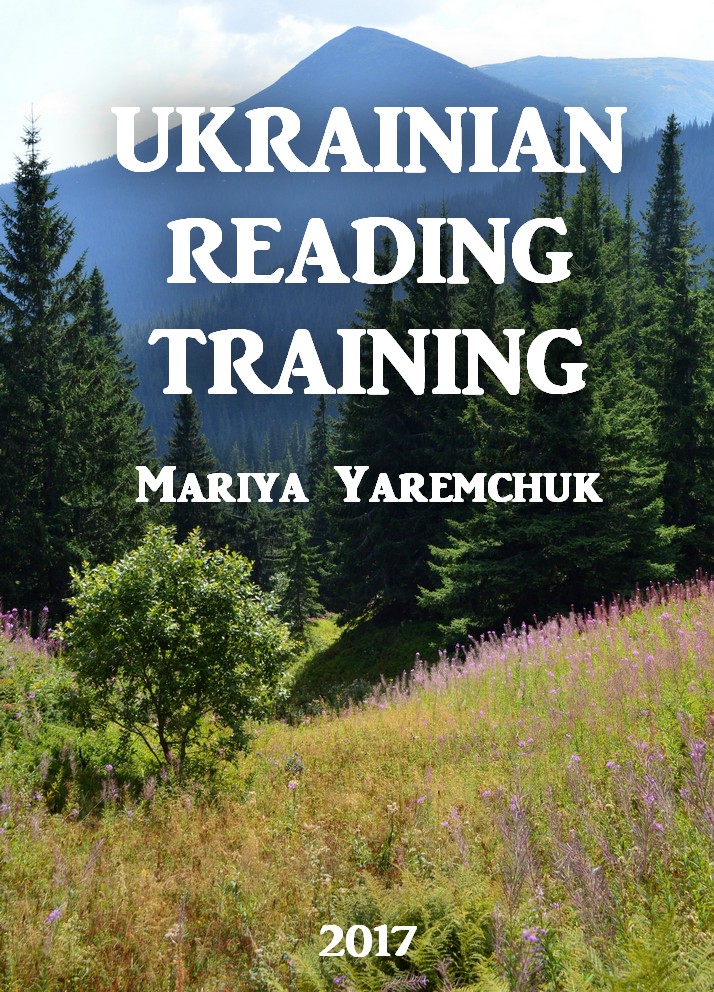
Ukrainian Reading Training
Discover Ukrainian Reading with
UKRAINIAN READING TRAINING
“Ukrainian Reading Training” is a meticulously crafted textbook designed to provide learners with a comprehensive foundation in reading and comprehending the Ukrainian language. This textbook serves as an essential tool for complete beginner and beginner learners who seek to get and develop a strong grasp of Ukrainian reading skills.
Key Features:
-
Progressive Learning Approach: The textbook follows a progressive learning approach, starting with the basics of the Ukrainian alphabet and gradually advancing to more complex reading exercises. Each excercise is carefully structured to build upon the knowledge gained in previous sections, ensuring a smooth and effective learning experience.
-
Effective Reading and Pronounciation Exercises: To provide learners with the best and fastest result I used the easiest, simple words with all the existing sounds and their combinations. This will give you a strong and profound reading and pronounciation skill.
3. Easy and logical Activities: “Ukrainian Reading Training” is based on interactive logically structured exercises and activities that encourage active engagement, reinforce comprehension, and naturally form the reading skill .
4. Supplementary Audio Resources: To facilitate pronunciation and listening comprehension, the textbook is accompanied by a necessary audio part. Learners have access to audio recordings of each reading passage, allowing them to practice listening, reading, comprehension of Ukrainian while following along with the text.
“Ukrainian Reading Training” is an indispensable first step for anyone seeking to learn, understand, use and love our wonderful language – Ukrainian.
Legend Of Kyiv

The Legend of Kyiv: The Founding of the Golden City
In the heart of Eastern Europe, nestled along the banks of the Dnipro River, there lies a city with a history as rich and golden as its name: Kyiv. The legend of Kyiv’s founding is a tale of prophecy, sacrifice, and the enduring spirit of its people.
Long, long ago, in a time when legends held sway over the land, there lived a young and noble warrior named Kyi. He was known for his valor, wisdom, and a deep love for the lush lands that surrounded the mighty Dnipro River. Kyi, along with his brothers Schek and Khoryv and their sister Lybid, came to this territoty from the North, from the Vikings’ lands, in their majestic ships, guided by a dream that beckoned them to create a great city.
The dream was not just a vision but a prophecy, foretold by a wise old man who visited Kyi in his sleep. In this dream, he saw a magnificent city, its spires gleaming like gold in the sun, and he heard the melodious voices of a people who sang of a brilliant future. The prophecy spoke of a city that would shine as a beacon of culture, wisdom, and strength, and that city was to be founded on the hills of the Dnipro.
Fired by this vision, Kyi and his siblings embarked on a journey, determined to find the place where their city would rise. They faced many trials and tribulations, from fierce storms on the river to battles with the untamed wilderness. Yet, they pressed on, guided by the unwavering hope that their prophecy would come true.
One day, as they ascended a hill overlooking the wide expanse of the Dnipro, the heavens seemed to smile upon them. There, beneath a cerulean sky, the siblings discovered a land of breathtaking beauty, abundant with flora and fauna, made of emerald hills and ancient forests. The place resonated with the energy and promise of their dream. This, they knew, was the chosen site for their city.
With unwavering determination, Kyi, Schek, Khoryv, and Lybid set to work. They marked the boundaries of their city, laying the foundation stone with their own hands. As they did, the land itself seemed to respond, providing fertile soil, fresh springs, and the warmth of the sun.
Years passed, and the city of Kyiv grew and prospered, just as the prophecy had foretold. Its golden spires gleamed in the sunlight, and its people, a harmonious blend of cultures and languages, celebrated its legacy. Kyiv became a beacon of knowledge, art, and culture, attracting scholars, artists, and visionaries from near and far.
The legend of Kyiv’s founding is a testament to the indomitable spirit of those who dream and dare to make those dreams come true. Today, the city of Kyiv stands as a living legend, a place where history and modernity coexist, and where the dreams of its founders endure in the hearts of its people. It is a city that reflects the golden legacy of its past, a legacy built on prophecy, sacrifice, and the enduring spirit of a people who dared to dream of greatness.
The Best Ways Of Learning a Foreign Language

Learning a foreign language is a transformative journey that opens doors to new cultures, opportunities, and personal growth. With the right approach, language learning can be an enjoyable and rewarding experience. Here, we explore some of the best ways to embark on this linguistic adventure.
**1. Immerse Yourself in the Language:
Immersion is one of the most effective ways to learn a foreign language. Surround yourself with the language as much as possible. If you can, visit a country where the language is spoken, or join a local community of speakers. Engaging in real conversations and hearing the language in its natural context accelerates the learning process.
**2. Take a Course:
Enrolling in a structured language course is a tried-and-true method of language learning. You can choose from in-person classes at language schools, online courses, or apps that offer comprehensive lessons. Courses provide a structured curriculum, which can be especially helpful for beginners.
**3. Practice Regularly:
Consistency is key when learning a language. Make a habit of practicing every day, even if it’s just for a short time. Daily practice helps reinforce what you’ve learned and prevents forgetfulness. Whether it’s reading, speaking, or listening, regular engagement is crucial.
**4. Use Language Learning Apps:
There is a wealth of language learning apps available that cater to different learning styles and levels. Apps like Duolingo, Rosetta Stone, and Memrise offer interactive lessons, quizzes, and exercises. They are particularly convenient for busy learners who can squeeze in lessons during their commute or free time.
**5. Watch Movies and TV Shows:
Watching movies, TV shows, and videos in the target language is an enjoyable way to improve your listening and comprehension skills. Start with subtitles in your native language and gradually switch to subtitles in the target language as your skills improve. It’s an entertaining way to get accustomed to native speakers’ accents and everyday conversations.
**6. Read Books and Newspapers:
Reading is a powerful way to enhance your vocabulary and grammar. Start with children’s books or simplified texts, then gradually progress to more complex literature and newspapers. Reading material related to your interests also keeps you motivated.
**7. Language Exchange Partners:
Find a language exchange partner who speaks the language you’re learning and wants to learn your native language. You can converse in both languages, helping each other practice and improve. It’s a mutually beneficial way to gain practical conversational skills.
**8. Take Advantage of Online Resources:
The internet is a treasure trove of language resources. Online forums, language learning communities, and YouTube channels dedicated to language learning can provide valuable insights, tips, and motivation.
**9. Travel and Practice:
Traveling to a country where the language is spoken is an immersive experience that can significantly boost your language skills. Practice conversing with locals, order food in restaurants, and navigate your way around the area. The real-life interactions you’ll have while traveling can be invaluable.
**10. Be Patient and Persistent:
Learning a new language is a marathon, not a sprint. It’s perfectly normal to encounter challenges and plateaus along the way. Stay patient and persistent, and remember that language learning is a gradual process, which requires regularity, you should have some practice every day at least 15-20 minutes. Celebrate your progress, no matter how small, and keep setting achievable goals.
In conclusion, learning a foreign language is a fulfilling and enriching endeavor. The best approach often involves a complex\combination of various methods, tailored to your learning style and goals. The key is to stay motivated, practice regularly, and enjoy the journey of discovering a new world through language. So, whether you’re learning for travel, career, or personal enrichment, take the first step and immerse yourself in the beautiful world of language acquisition.
The Lost Art of Handwriting: Rediscovering the Benefits and Advantages

In an increasingly digital world where the click of a keyboard or the swipe of a touchscreen has become the norm, the art of handwriting is often overlooked and underestimated. However, the benefits and advantages of putting pen to paper go far beyond mere nostalgia. Handwriting is a skill that enhances cognition, creativity, and personal well-being, and its relevance remains as strong as ever.
**1. Cognitive Enhancement:
Handwriting engages different parts of the brain compared to typing. The physical act of forming letters and words on paper requires fine motor skills, hand-eye coordination, and spatial awareness. These cognitive processes stimulate the brain and enhance memory and comprehension. Research shows that students who take notes by hand tend to retain and understand information better than those who type their notes.
**2. Enhanced Learning:
For students, writing notes and assignments by hand promotes active learning. The tactile experience of writing reinforces information, making it easier to recall later. This is particularly beneficial in educational settings where information retention and understanding are essential.
**3. Boosting Creativity:
Handwriting encourages creativity and free-flowing thought. The act of writing by hand allows for more personal expression and a deeper connection to one’s thoughts and ideas. Many writers, poets, and artists still prefer to draft their work by hand, finding that it offers a unique connection between their minds and the physical page.
**4. Improved Concentration:
Handwriting can be a meditative and focused activity. When you put pen to paper, you enter a state of flow where the world around you fades, and your thoughts become the primary focus. This form of mindfulness can be an excellent stress reliever and aid in concentration.
**5. Personal Connection:
Handwritten letters, notes, and cards carry a personal touch that is unmatched by digital communication. Receiving a handwritten message conveys a sense of thoughtfulness and effort. It is a tangible symbol of connection and care in an increasingly fast-paced and digital world.
**6. Art of Penmanship:
A well-developed handwriting style is a form of self-expression and individuality. Your handwriting is as unique as your fingerprint, and it tells a story about you. Cultivating good penmanship can be a source of pride and is a testament to your attention to detail.
**7. Timeless Skill:
While technology advances at a rapid pace, handwriting remains a timeless skill. In the event of technological failures or the need to communicate in unconventional situations, the ability to write by hand can be invaluable.
**8. Historical and Cultural Significance:
Handwriting has played a pivotal role throughout history in documenting and preserving cultural and historical heritage. Ancient manuscripts, letters, and diaries have offered insights into the lives and thoughts of people long gone. The preservation of handwriting ensures that we continue to leave a tangible mark on our world for future generations.
In conclusion, the art of handwriting is a valuable and versatile skill that offers cognitive, creative, and personal benefits. Its importance extends from the classroom to the world of creativity, from fostering a deeper connection with one’s thoughts to providing a personal touch in communication. It’s a skill that remains relevant and is worthy of preservation in our fast-paced, digital age. So, whether you’re jotting down notes, writing a heartfelt letter, or simply practicing the beauty of penmanship, remember that the benefits and advantages of handwriting are timeless and enduring.
You can learn Ukrainian cursive easy and fast with our Ukrainian Writing Training:)

The Advantages of Online Language Learning
In the dynamic landscape of education, online lessons have emerged as a transformative force, particularly in the realm of foreign language acquisition. Leveraging the power of technology, these virtual classrooms offer a range of advantages that redefine the language learning experience.
1. Flexibility and Convenience:
- Online lessons provide unparalleled flexibility, allowing learners to schedule sessions at their convenience. This flexibility accommodates diverse schedules, making language learning accessible to individuals with varying commitments and lifestyles.

2. Personalized Learning Paths:
- Tailored curricula and personalized lesson plans cater to the individual needs and learning styles of each student. Online platforms often offer adaptive learning technologies that adjust the pace and content based on the learner’s progress, ensuring optimal comprehension and retention.
3. Access to Global Expertise:
- Online language learning connects learners with experienced instructors and native speakers from around the world. This exposure to diverse accents, cultural insights, and linguistic nuances provides a well-rounded language education that extends beyond the confines of traditional classrooms.
4. Interactive Multimedia Resources:
- Online lessons leverage a plethora of multimedia resources, including videos, audio clips, interactive exercises, and virtual simulations. These resources engage multiple senses, enhancing the learning experience and addressing various learning preferences.
5. Real-time Communication and Collaboration:
- Virtual classrooms facilitate real-time communication through video conferencing, enabling learners to interact seamlessly with instructors and fellow students. Collaborative tools, such as chat features and shared documents, foster a sense of community and enhance the social aspect of language learning.
6. Self-Paced Learning:
- Online lessons empower learners to progress at their own pace. Self-paced learning allows individuals to revisit challenging concepts, delve deeper into areas of interest, and tailor their language learning journey to match their unique abilities and preferences.
7. Cost-Effective and Accessible:
- Eliminating the need for travel, accommodation, and physical resources, online language learning is often more cost-effective than traditional alternatives. Additionally, learners from diverse geographical locations gain access to high-quality language education without geographical constraints.
8. Recorded Sessions for Review:
- The ability to record online sessions provides a valuable resource for learners. Recorded lessons can be revisited for review, allowing students to reinforce concepts, practice pronunciation, and consolidate their understanding at their own convenience.
9. Instant Feedback and Assessment:
- Online platforms often include instant feedback mechanisms, allowing learners to receive timely assessments of their progress. This immediacy enables individuals to address misconceptions, refine language skills, and track their advancement in real-time.
10. Global Networking Opportunities:
- Online language learning communities offer opportunities for global networking. Learners can connect with peers from diverse backgrounds, practice language skills through virtual language exchange programs, and participate in forums or discussion groups dedicated to language and culture.
In conclusion, the advantages of online language learning extend far beyond the traditional classroom setting. The flexibility, personalization, and diverse resources offered by online platforms have revolutionized the language learning landscape, providing learners with an enriching and accessible pathway to linguistic proficiency. As technology continues to evolve, the world of online language learning promises to remain at the forefront of educational innovation, opening doors to linguistic fluency and intercultural understanding.